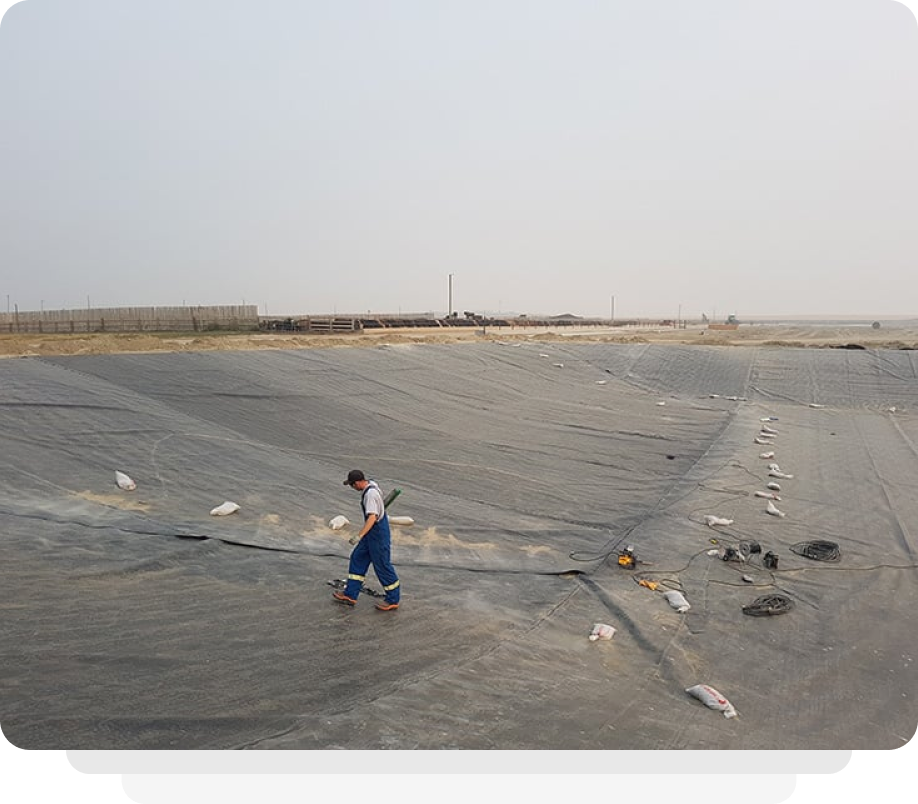
Polyethylene Liners
Polyethylene liners are an industrial product for containment applications. Polyethylene liners are used in agriculture, construction, and energy-related industries for primary and secondary containment applications.
Product Details
Lighter and more flexible than HDPE liners, LLDPE is the liner of choice for most secondary containment applications. Providing much of the same durability found in high-density liners, with the additional benefits of flexibility LLDPE conforms to any shape containment with fewer stress cracks or tears.
Prefabricated in our shop containment LLDPE liners are delivered ready to install with no onsite welding preparations required.
High-Density Polyethylene geomembrane liners are often used in agriculture and construction for primary containment of fresh and wastewater storage. Used throughout the world, HDPE liners are UV and chemical-resistant. Less flexible than LLDPE, HDPE provides higher specific strength and can withstand higher temperatures.
Panel Fabrication
When building a containment liner in the shop or in the field the material is rolled out with overlapping edges creating panels. The welder runs along the seam where the two panels overlap and use heat to melt and bond the panel sections together.Extrusion Welding
Extrusion welding is taking plastic welding rod spooled from the manufacturer of the liner and feeding it into a handheld extrusion gun, it takes the welding rod, heats it up to the melting point, forces it through a screw-driven barrel, and comes out of the Teflon tip. Extruders also always have an additional wide nozzle next to the tip for hot air to prep the weld area to soften the base sheets of material to allow for excellent adhesion of both the molten welding rod and base material sheets. Extruders aren’t just meant for flexible sheet welding, they’re also used in rigid plastic fabrication, plastic pipe welding as well as many other applications. FLSI has many different types, sizes, and models of extruders as we’re such a diverse fabricator and installer, this allows us to tackle any project challenges.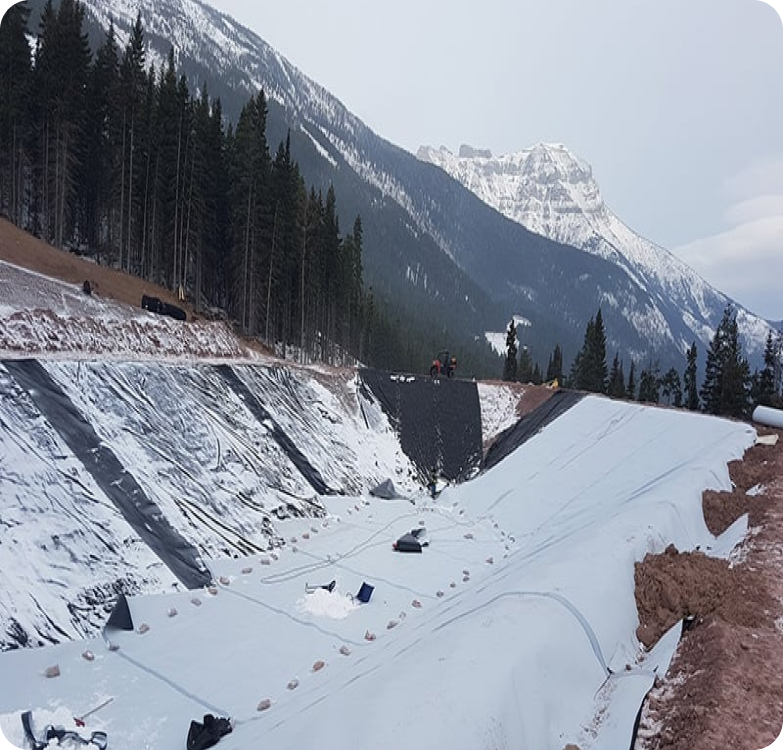
High and Low-density PE protection from leaks, spills, and for storage.
It is possible to make any size or shape liner by welding together panels. Panel construction can be performed in our shop or in the field, creating a reliable and cost-effective barrier of protection for any size project.
For heavier-duty applications we also supply and install HDPE geomembrane liner. Not sure which suits your site? Compare HDPE vs LLDPE geomembranes on puncture resistance, flexibility and cost.Request a Quote
Selecting the right liner is critical for a successful containment project.
We can help with volume calculations, engineered drawings, material selection, as well as installation, fabrication, and project scoping. Fill out the request form to get started on your next containment project.
Request a Quote
Site Preparation and Installation
Surface Preparation
The earth upon which the liner will be placed must be smooth, dry, and free from sharp rocks, roots, vegetation, and other foreign material. A compacted substrate is advisable to prevent settling. Compaction around pipes and structures is especially important.
Sub-grade material shall be prepared as per the following conditions:
- If sub-grade material is 12 mm or less, the Liner can be placed directly onto sub-grade once it has been compacted and drum rolled.
- If sub-grade material is 19mm to 75mm a minimum 240g/m2 geotextile must be placed on the compacted and drum rolled sub-grade prior to the placement of all liner material.
- If sub-grade consists of 150mm – 300mm material, a 100mm thick layer of sand or a 12.5 mm minus granular material compacted and drum rolled, must be placed on the compacted and drum rolled sub-grade material prior to the placement of the Liner.
Installation (Pond)
- Dig the anchor trench as shown on the shop drawing or the engineering drawings. ALWAYS THROW EARTH FROM TRENCH AWAY FROM SIDE SLOPE.
- Crew size will depend on the project size. A minimum of 6 people required, most projects need at least 10 people to spread panels.
- Make sure to have plenty of sand bags placed around the perimeter of the area to be lined.
- Do not start deployment before sand bags are placed. Do not deploy during windy conditions.
- Panel is accordion folded then rolled. Be careful to note dimensions and direction.
- Place panel at the appropriate corner of the cell.
- Unroll the entire length.
- Separate crew evenly over length.
- Pull carefully over width of area. (When friction makes the pulling difficult flip air under panel) think air hockey puck.
- If you are really stuck tighten up crew and pull in sections.
- Equipment can be used by clamping the liner between 2 x 6’s.
Product Warranty